Telephone & Digital Voice Services
If you are experiencing problems with your home phone or digital voice service, Wavexa provides professional support to help restore clear, reliable communication. We help homeowners with telephone faults, digital voice setup, poor call quality, and broadband-based phone issues, offering practical solutions tailored to modern homes.
As more households move from traditional landlines to digital voice phone systems, many customers are dealing with new setup and connection problems. Issues such as no dial tone, crackling phone lines, dropped calls, unclear audio, and handsets not connecting are becoming increasingly common. Because digital voice relies on your broadband connection, router setup and network performance can have a direct impact on call quality.
At Wavexa, we provide expert help with telephone and digital voice troubleshooting, from initial setup through to fault finding and performance improvement. Whether you need support after changing broadband provider, help connecting a cordless handset, or a solution for unreliable home phone service, we can help get everything working properly.
~ Our Telephone & Digital Voice Services ~
* Digital voice setup and installation *
* Home telephone fault diagnosis *
* Poor call quality troubleshooting *
* Cordless phone setup and pairing *
* Router and digital voice connection checks *
* Support after switching from landline to digital voice *
* Telephone socket and connection inspection *
* Home office phone setup *
* Faulty handset and equipment replacement *
* Ongoing telephone support and maintenance *
We focus on making home phone systems and digital voice services easier to use, more reliable, and better suited to modern living. Whether your issue is with the phone itself, the router connection, or the overall setup, Wavexa offers practical support to improve performance and reliability.
Need help with telephone problems or digital voice setup? Contact Wavexa for professional telephone and digital voice support.
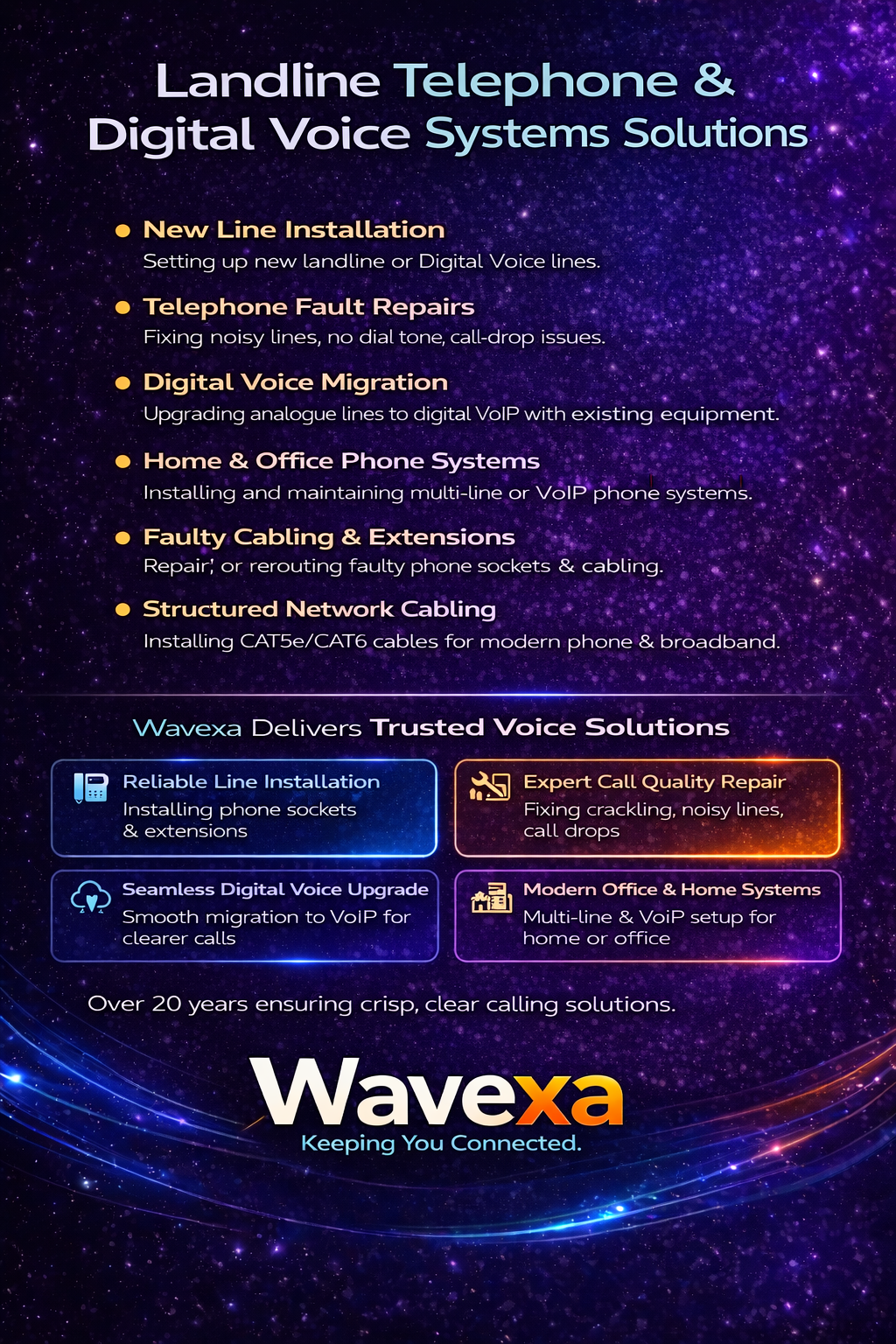



Digital Voice and Telephone services
You may already be among the hundreds of thousands of individuals who have successfully transitioned to a digital voice telephone system, adapting to a more modern method of communication that replaces traditional analogue lines. Alternatively, you could be one of the many who have yet to complete the switch but are expected to do so before the January 2027 deadline, when the existing system is scheduled to be permanently retired. While this nationwide migration promises long-term benefits—such as improved call quality, enhanced features, and a more resilient infrastructure—it is not without its challenges. Many people, particularly older adults or those less familiar with digital technology, may find the transition confusing or overwhelming. Setting up new equipment, understanding how internet-based calling works, or troubleshooting issues can create frustration and uncertainty. There are also practical concerns. Unlike traditional landlines, digital voice systems often rely on an internet connection and mains electricity, meaning that power outages or broadband disruptions can affect service availability. This has raised concerns for vulnerable individuals who depend on reliable phone access, including those using telecare devices, emergency alarms, or medical monitoring systems that may not be immediately compatible with the new technology. In rural or underserved areas, limited broadband reliability can further complicate the transition, making digital voice systems less dependable than the legacy network they replace. In these situations, support from an experienced professional can make a significant difference. A Wavexa expert technician can guide you through every stage of the transition, from assessing your current setup to recommending the most suitable equipment for your needs. They can handle installation, ensure your devices are correctly configured, and check compatibility with any existing telecare or specialist systems. Importantly, they can also provide reassurance by explaining how everything works in clear, simple terms, helping to reduce stress and avoid common pitfalls. With expert assistance, you can feel confident that your digital voice service is set up safely, reliably, and ready for the future. Whether you have already made the switch or are preparing to do so, understanding these potential challenges is essential. With proper support, clear guidance, and adequate preparation, the transition can be managed more smoothly—ensuring that no one is left disconnected as the UK moves toward a fully digital communications network.
How can we help?
A Wavexa tech expert can provide straightforward, hands-on support to make the transition to digital voice systems much easier.
They handle the full setup, ensuring your equipment is installed and configured correctly, so you avoid confusion or technical issues. They can also assess your broadband and overall setup to improve reliability, and advise on solutions such as backup power to keep your service running during outages. Reconnect your existing telephone sockets to ensure they are digital voice ready and continue to work as they did previously. This includes things like emergency telephones inside disability aids such as lifts or stair lifts, bell ringers for hard of hearing, external bell ringers for farms and yards, nothing is beyond possibility.
For those using telecare devices or alarms, a Wavexa technician can check compatibility and ensure everything works safely with the new system—giving peace of mind to more vulnerable users.
Just as importantly, they offer clear, jargon-free guidance, helping you understand how your new system works and what to do if issues arise. Overall, they help prevent problems, resolve issues quickly, and ensure your service is reliable from day one.
Why would I need this help?
You might want support because the move to digital voice can involve more than a simple swap of equipment. The system relies on your broadband and power supply, so your setup needs to be configured correctly to avoid issues like dropped calls or inconsistent performance.
There can also be added complexity if you use devices such as telecare alarms or monitoring systems, as these need to be checked to ensure they work properly with the new technology.
Having expert help means your system is set up correctly from the start, any potential issues are identified early, and everything is tested to work as expected—helping you avoid disruption and giving you confidence in your service.
What are the differences?
Analogue (PSTN) and digital voice systems work in different ways and offer different levels of service.
An analogue phone system uses traditional copper phone lines. It’s simple and reliable, and it often still works during a power cut because it’s powered from the telephone network. However, it only supports basic phone calls and is now being phased out.
A digital voice system uses your internet connection to make calls. It offers more features, like call forwarding and voicemail options, but it depends on your broadband and electricity. If either goes down, your phone service may stop working unless you have a backup.
Another difference is compatibility. Older devices like some alarm systems or fax machines usually work easily with analogue lines, but may need checking or adapting to work with digital systems.
In short, analogue is simple and dependable but outdated, while digital is more flexible and modern but relies on your internet and power to work properly.
What problems may this cause?
In a real home environment, the switch from analogue to digital voice can lead to a few practical issues if everything isn’t set up properly.
One of the main problems is loss of service during power cuts. Unlike traditional landlines, digital voice systems stop working if your router loses power, which means you won’t be able to make or receive calls unless you have a backup in place.
Another common issue is broadband reliability. If your internet connection is slow, unstable, or drops out, your phone service can be affected—leading to poor call quality, delays, or missed calls.
There can also be device compatibility problems. Equipment like telecare alarms, emergency call systems, or older devices may not work straight away with a digital setup and may need testing or adapting.
Inside the home, setup and wiring can cause confusion. Phones may need to be plugged into a router instead of wall sockets, and existing extensions around the house might not work without changes.
Finally, there’s the issue of day-to-day usability. If you’re used to a traditional landline, the new system can feel different to use, especially if it involves new equipment or slightly different ways of making and receiving calls.
All of these are manageable, but they can cause disruption if not addressed early.